Loading
The Contest Engine
Everyone else tells you a plot is flagged. We prove it shouldn't be.
Incumbents sell compliance screening. Kaawa sells market access defence: when the EU's map wrongly calls your coffee a forest, we build the case that gets your container moving.
91%overall accuracy of the EU's 2020 forest mapJRC, 21,752 expert-interpreted samples
18%commission error for forest — land wrongly classified as forestSame JRC assessment
10 ma pixel on that map: a shade tree's crown and the coffee beneath it read as one canopyJRC GFC2020 V3 resolution — we are measuring what it flags in Ugandan coffee now
Why a coffee garden looks like forest
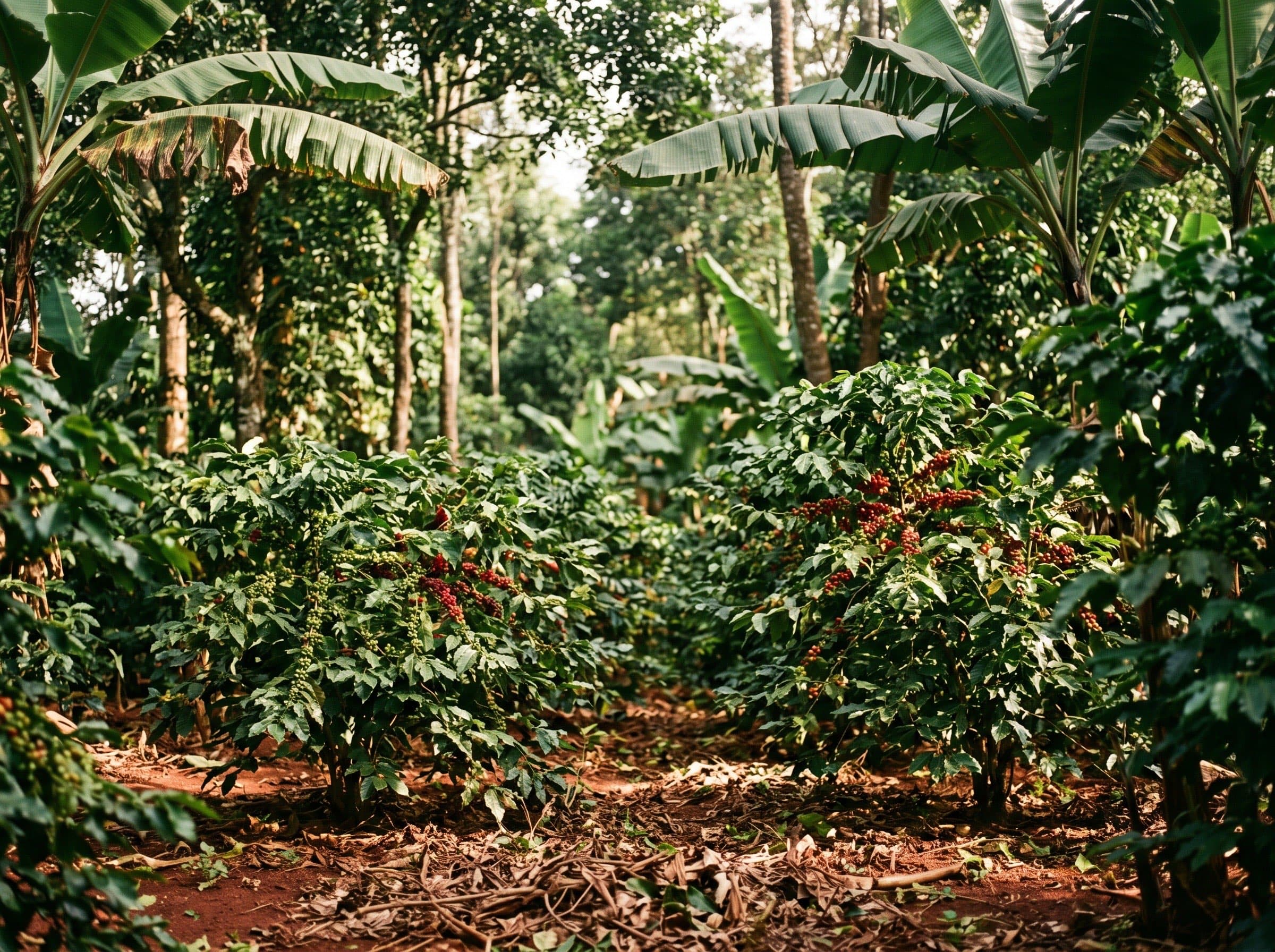
Ugandan coffee is grown under shade trees. At 10 metres a pixel, a shade-grown garden is a canopy — and a canopy is what the map calls forest. When a farmer prunes or replants, the canopy thins for a season and the change detector reads it as clearing after 2020.
The map is not wrong about the trees. It is wrong about what they mean. That difference is a case to be made, with evidence, by a person.
From orbit: a green block the map labels forest.

From the ground: coffee, planted in rows, under Albizia shade.
What happens when a plot is flagged
Step 1
Classify
Likely-true: a clear conversion signature, an abrupt boundary. Likely-false: agroforestry misread, cyclical pruning, shade management, cloud artefact, geolocation offset.Step 2
Marshal counter-evidence
Sentinel-2 continuity since 2018, planted-vs-primary forest type, ground photographs, the farmer's attestation, comparison with neighbouring plots.Step 3
Generate the Contest Pack
A formal document: the flag, the counter-evidence, the methodology and a reasoned conclusion. Built from source records, reproducible.Step 4
Human sign-off
We never auto-clear a flag. That is how a platform becomes complicit. A named reviewer signs, and sometimes the answer is "the flag is right".Step 5
Feed the corpus
Every adjudicated case is a labelled example. The more Ugandan coffee we review, the better we get at exactly the land the public map handles worst.Anatomy of a Contest Pack
One document your buyer, your auditor and a competent authority can all read
Every section cites the dataset version it used and the person who checked it. A pack is attached to the plot, the supplier and the statement it protects.
Priced per contested plot and quoted alongside your platform rate — against a blocked container, not against our cost. The first screening of a large supplier base produces the biggest batch of false positives, which is when you need it most.
Contest Pack · CP-2026-0412Garden UG-KAS-01184 · Nakato Grace · Kasese
Signed · likely-false confirmed- 1The flagJRC GFC2020 V3 · 74% forest overlap · change event Q2 2023, confidence 0.62
- 2ClassificationLikely-false · cyclical pruning in shade agroforestry
- 3Counter-evidenceForest type: planted · Sentinel-2 2018–2026, 34 quarters, no clearing · 6 geotagged ground photos · farmer attestation (Lukonzo, transcribed) · 4 neighbouring plots, same signature
- 4MethodologyScreening v1.3 · GFC2020 V3 · GFT2020 V1 · S2 mosaics 2026-Q3 · generated 12 Oct 2026
- 5Reasoned conclusionCanopy present throughout 2020; the 2023 event is a thinning consistent with pruning; no conversion.
- 6Sign-off[Reviewer name], Kaawa · 14 Oct 2026 · record #c7a1…e9
Map history playback
Scrub seven years and watch a coffee garden stay a coffee garden
Quarterly Sentinel-2 mosaics from 2018, the JRC forest mask you can switch on and off, change events pinned to their dates, your boundary on top, ground photos anchored where they were taken. Conviction is visual in a way a risk score never is.
Q3 2020JRC forest mask · onGround photos · 6
What we don't yet know, said plainly
There is no precedent for how competent authorities will treat a rebuttal of the reference map. We are engaging one early, we keep a human signature on every pack, and when the flag is right we tell you so and attach the mitigation plan instead. We are measuring how often the map flags real Ugandan coffee gardens and will publish the result here.